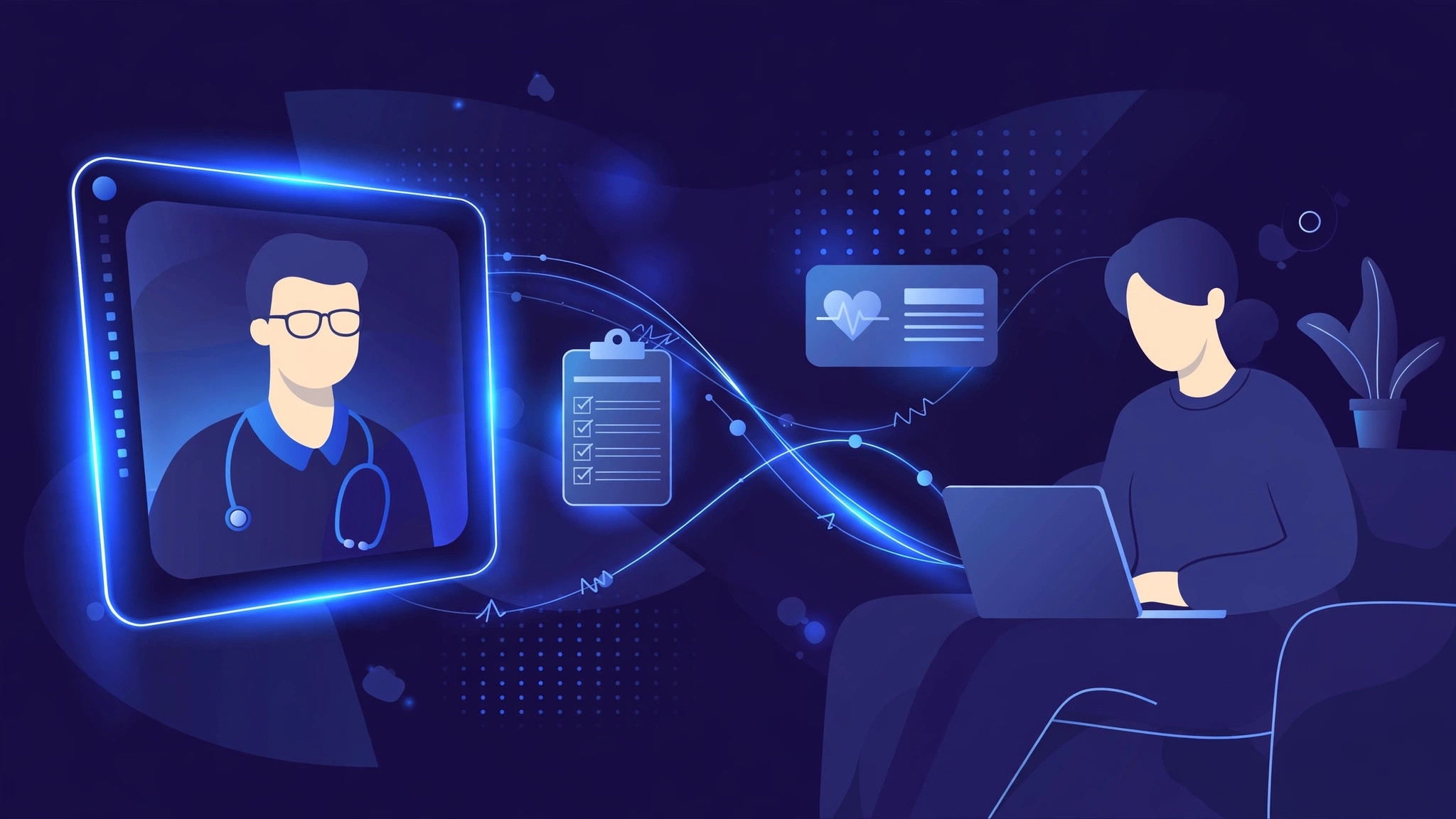
Telemedicine software lets a doctor and a patient hold a complete medical consultation without being in the same room. It is much more than a video call: it books the appointment, runs a virtual waiting room, carries the live consultation, writes the visit notes into the patient's record, sends a prescription to the pharmacy, and handles payment and billing — all in one connected flow. The video is the visible part; the scheduling, records, prescribing and compliance underneath are what make it a clinical system rather than a chat app.
How a video visit actually works
A video consultation runs on real-time media technology, usually WebRTC, which lets browsers and apps exchange audio and video directly with very low delay. The platform adds a media server in the middle so group calls, recording and network fallbacks work reliably. When a patient's connection weakens, the system drops video quality before it drops the call, and falls back to audio-only rather than ending the visit. A dropped call mid-consultation is a clinical problem, not just a glitch, so the platform keeps the session state so the visit can be rejoined or safely rescheduled.
Before the call, the patient completes intake: symptoms, current medication, allergies and consent forms. The answers reach the doctor before the call, so the consultation starts with context instead of ten minutes of questions, and they become part of the visit record.
Scheduling and the virtual waiting room
Booking works like any appointment system, but with a few extra rules. The platform holds each doctor's availability, the length of each visit type, and buffer time between consultations. Patients pick a slot, and the system sends reminders by message or email to cut no-shows. At the appointment time, the patient enters a virtual waiting room — a queue the doctor can see and manage. The doctor admits patients one at a time, just like a clinic corridor, and the system logs wait times and late arrivals so the practice can see where its schedule slips.
For on-demand services, patients join a first-available line and are matched to the next free doctor, with triage questions routing urgent cases ahead of routine ones.
E-prescriptions and the pharmacy link
When the doctor decides on medication, the prescription is created inside the platform and sent electronically to the patient's chosen pharmacy. The system checks the drug against the patient's recorded allergies and current medication, flags interactions, and verifies the dosage against standard ranges. The patient gets a confirmation with pickup or delivery details, and the prescription is stored in their record so refills can be handled without a new consultation where the rules allow.
Because prescribing is regulated, the platform records exactly who prescribed what, when, and under which licence. Controlled medicines carry extra checks, and the system must refuse or escalate prescriptions that fall outside what a remote consultation legally covers.
Patient records and EHR integration
Every visit produces a clinical record: the intake answers, the doctor's notes, the diagnosis, the prescription and any follow-up plan. Good telemedicine software writes this back into the clinic or hospital's electronic health record (EHR), so the next doctor who sees the patient — in person or online — works from the same history. Without that write-back, visit notes sit outside the legal medical record and staff end up retyping them, which is where errors creep in.
Integration usually runs on the FHIR standard for exchanging health data, with older HL7 feeds still common in hospitals. The platform reads the patient's history before the visit and writes the summary back afterwards, and lab results can be attached the same way.
Payments, billing and eligibility
Most platforms collect payment at booking or immediately after the visit. Where insurance applies, the system checks the patient's eligibility before the consultation, so nobody discovers after the call that the visit is not covered. The visit is then coded for billing — the diagnosis and procedure codes that insurers and finance teams need — and the claim is generated from the same record the doctor already wrote, rather than from a separate billing form.
For cash-pay services, the flow is simpler: a published price per visit type, payment up front, and a receipt in the patient's account.
Security, privacy and compliance
Health data is among the most sensitive data a system can hold, so telemedicine platforms are built around strict rules. Video and messages are encrypted in transit, records are encrypted at rest, and access is role-based: a doctor sees their own patients, a receptionist sees schedules but not clinical notes, and every access is logged. Consent is recorded with the version the patient accepted, not just a checkbox, because an audit will ask exactly what was agreed and when.
The rules vary by region — HIPAA in the United States, GDPR in Europe, and national digital-health frameworks elsewhere — but the pattern is the same: keep clinical data and video infrastructure separate, log every handoff, and never treat compliance as a feature bolted on at the end.
What to look for in telemedicine software
If you are choosing or building a platform, judge it on the full visit, not the video quality alone. Check that scheduling, waiting room, consultation, prescribing, records and billing connect without retyping. Ask how it writes back to your EHR, how prescriptions reach pharmacies, how it behaves on a weak connection, and what its audit trail looks like. A demo on a fast office connection tells you nothing about a patient on a rural mobile network — that is the connection the system has to survive.
Also look at the edges: how follow-ups are booked, how chronic patients are monitored between visits, and how the platform handles cases it cannot treat remotely. The best systems know their limits and route those patients to in-person care.
Frequently asked questions
What is telemedicine software?
Telemedicine software is the system that runs remote medical consultations end to end: booking, virtual waiting room, live video visit, clinical notes, e-prescriptions, patient records and billing, all connected in one flow.
How is telemedicine different from a video call?
A video call only connects two people. Telemedicine software adds scheduling, intake, clinical documentation, prescribing, pharmacy delivery, records integration and billing — and it produces a medical encounter record with the same legal standing as an in-person visit.
Can doctors prescribe medicine during a video consultation?
Yes, in most regions. The doctor creates an e-prescription inside the platform, which checks allergies and interactions and sends it electronically to the patient's pharmacy. Some medicines, such as controlled substances, carry extra identity and approval checks.
Does telemedicine software connect to existing hospital systems?
It should. Good platforms integrate with electronic health records using the FHIR standard, reading patient history before the visit and writing the visit summary back afterwards, so remote and in-person care share one record.
Talk to InRay Labs
If you are building or replacing healthcare software — a telemedicine platform, a patient portal, a scheduling system or an EHR integration — InRay Labs builds these systems for healthcare providers. Talk to us about your project and we will help you scope it.